
Identifying a Western Hemlock may seem daunting, but with a few key characteristics, it can be done with ease. This coniferous evergreen tree is native to North America and can grow up to 230 feet tall. Its bark is thin and furrowed, similar to that of Douglas-fir, and its feathery foliage is a defining feature.
Western Hemlock identification does not have to be hard. You can simply look for its narrow crown and down-sweeping branches. Its new growth at the top is conspicuously drooping, and its delicate foliage is feathery and soft to the touch. The tree typically grows 30 to 50 meters tall and 1 to 1.5 meters in diameter, with a lifespan of around 500 years.
Key Takeaways
- Western Hemlocks are native to North America and can grow up to 230 feet tall.
- Look for the narrow crown, down-sweeping branches, and feathery foliage to identify the Western Hemlock.
- The tree typically grows 30 to 50 meters tall and 1 to 1.5 meters in diameter, with a lifespan of around 500 years.
Table of Contents
Western Hemlock Identification: A Step-by-Step Guide
When trying to identify a Western Hemlock, there are several key characteristics to look for. These include needles and branches, cones and seeds, bark and trunk, and tree shape and crown.
Needles and Branches: The Basics
Western Hemlock has short, flat needles that are about 1 inch long and are attached to the branches in a spiral pattern. The needles are dark green on top and have two white stripes on the underside. The branches of a Western Hemlock tree droop downward, giving it a graceful appearance.
Cones and Seeds: Unique Features
Western Hemlock trees produce small, egg-shaped cones that are about 1 inch long. The cones are light brown in color and have thin, papery scales. Each cone contains about 20-30 seeds, which are small and winged.
Bark Texture and Color: What to Look For
The bark of a Western Hemlock tree is reddish-purple in color when young and turns gray-brown as the tree ages. The bark is thin and has a scaly texture. The trunk of a mature Western Hemlock tree can reach up to 5 feet in diameter and is straight with a slight taper.
Tree Shape and Crown
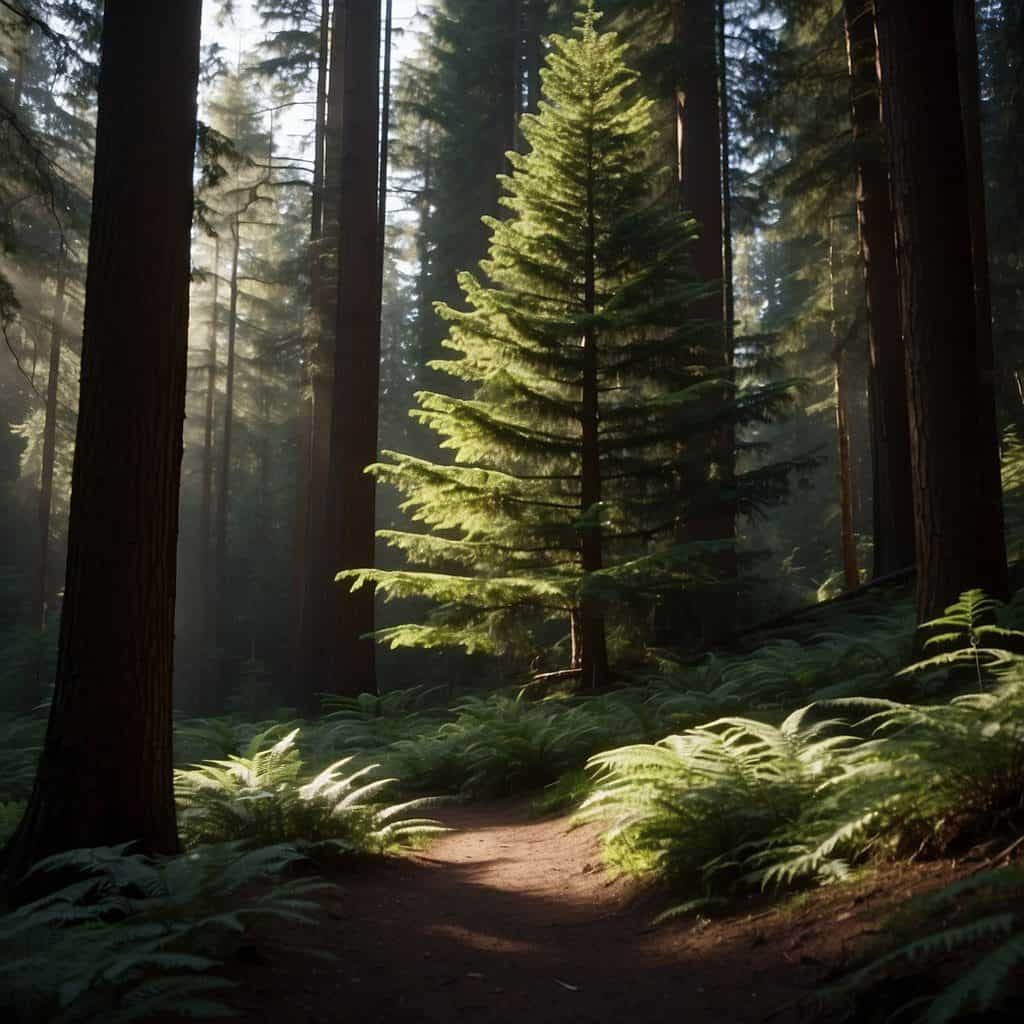
The Western Hemlock tree has a narrow crown with mostly down-sweeping branches. The tree has a conical shape when young, but as it ages, it becomes more cylindrical. The Western Hemlock is an evergreen conifer and can grow up to 200 feet tall but more typically grows to be around 30-50 meters tall.
By looking for these identifying characteristics of the Western Hemlock, you can easily distinguish it from other trees in the forest. These characteristics include the needles and branches, cones and seeds, bark and trunk, and tree shape and crown.
Habitat and Distribution: Where to Find Western Hemlock
Western hemlock is a large evergreen tree that can be found throughout the Pacific Coast of North America, from Alaska to California. This species is commonly found in rocky mountains, coastal ranges, and other areas with high levels of precipitation.
Geographic Range of Western Hemlocks
Western hemlock is distributed throughout the Pacific Coast of North America, from Alaska to California. It is commonly found in the coastal ranges and mountains of British Columbia, Washington, Oregon, and California.
Climate and Soil Preferences
Western hemlock prefers cool, moist climates and can tolerate a wide range of soil types. It grows best in soils with a pH between 5.0 and 6.5 and with high levels of organic matter. This species is also shade-tolerant and can grow in areas with low levels of light.
Associated Flora and Fauna
Western hemlock is often found growing alongside other coniferous species, such as Douglas-fir and Sitka spruce. This tree also provides habitat for a variety of wildlife species, including black-tailed deer, Roosevelt elk, black bear, mountain beaver, brush rabbit, and snowshoe hare.
Western hemlock is a common species found throughout the Pacific Coast of North America, growing best in cool, moist climates and a wide range of soil types. This species is often found growing alongside other coniferous species and provides habitat for a variety of wildlife species.
Understanding Growth and Development Patterns
Seedling and Maturation
To identify a Western Hemlock, it’s essential to understand its growth and development. The seeds of Western Hemlock are small and light, measuring about 2-3 mm long. They have wings that help them disperse in the wind. The seeds need moist soil and shade to germinate. Once germinated, the seedlings grow slowly, often starting in rotting wood beneath other trees. As they become established, they may add up to two feet of growth each year and will begin to dominate the forests where they are found.
Lifespan and Size
The Western Hemlock is a long-lived tree with a lifespan of up to 800 years. It grows to an average height of 50-70 feet and can reach up to 200 feet in height. The tree has a narrow, conical shape and a dense, dark green canopy. The bark of the Western Hemlock is thin, gray-brown, and scaly. The cones of the Western Hemlock are small, measuring about 1 inch long, and hang pendulous from branches.
The Western Hemlock is a slow-growing tree with a growth rate of about 1-2 feet per year. It prefers a mild, humid climate with frequent fog and precipitation during the growing season. The best stands are in the humid and superhumid coastal regions. In subhumid regions with relatively dry growing seasons, Western Hemlock is confined primarily to northerly aspects and higher elevations.
To identify a Western Hemlock, you need to look at its narrow, conical shape, dense, dark green canopy, thin, gray-brown, and scaly bark, and small, pendulous cones. Additionally, the tree has a slow growth rate and a long lifespan and prefers a mild, humid climate.
Ecological Role and Conservation Status of Western Hemlocks
Ecological Role and Partnerships
Western Hemlock plays a significant role in its ecosystem, forming rich partnerships with various mycorrhizal fungi, which assist in mineral and water absorption. This relationship includes associations with edible mushrooms like Pacific Golden Chanterelle and Admirable Bolete. Additionally, its shallow root system makes it vulnerable to wind storms and drought, and its wood is prone to rot due to being less protected by pitch compared to other conifers
Environmental Impact
Western hemlock plays an essential role in the ecosystem as it provides shade and shelter for many organisms. It is a shade-tolerant tree that grows well in damp and cool environments, making it an ideal home for various species of birds, insects, and mammals. The tree’s organic matter also contributes to the soil’s nutrient content, benefiting other plants in the area.
Economic Importance
Western hemlock is a valuable resource in the timber industry, as it is commonly used for lumber, timber, pulp, paper, poles, railway ties, construction lumber, wood pulp, pilings, and furniture. Its wood is strong and durable, making it an excellent choice for many construction and manufacturing purposes.
Cultural and Alternative Uses
In addition to its economic value, Western hemlock has cultural and alternative uses. Native people used hemlock bark as a tanning agent and cleansing solution owing to its high tannin content. Its inner bark was used by the Alaska Indians to produce coarse bread. The tree is also used as an ornamental tree in gardens and as a source of dye and medicine.
Western hemlock-spruce and Coast hemlock are often confused with Western hemlock. While they share similar characteristics, they are not the same species. It is important to properly identify the tree before using it for any purpose.
Western hemlock is a valuable resource in the timber industry, provides shade and shelter for many organisms, and has cultural and alternative uses. Its wood is strong and durable, making it an excellent choice for many construction and manufacturing purposes. With proper identification, this tree can be used for various purposes while still maintaining its ecological role in the environment.
Conservation and Threats
Disease and Pests
Western hemlocks are susceptible to various diseases and pests. Dwarf mistletoe is a parasitic plant that can weaken and kill trees. Other pests include hemlock woolly adelgid and spider mites.
Environmental Challenges
Western hemlocks are vulnerable to environmental challenges such as fire, drought, and a shallow root system. Fire can damage or kill trees, while drought can cause stress and make them more susceptible to pests and disease.
The impact of climate change, particularly increased summer drought and high temperatures, has led to a more prominent presence of the fungal pathogen “web rot,” contributing to the death of Western Hemlock. This change in climate conditions has also directly stressed hemlocks, making them more susceptible to disease and potentially leading to a reduction in their range, especially in the southwestern portion of its distribution.
Conservation Status
Despite facing several threats, the western hemlock is currently classified as “Least Concern” on the IUCN Red List. However, evergreen forests are important habitats for many species, and conservation efforts are necessary to protect them.
The western hemlock is a beautiful and valuable tree that faces several threats. By understanding these threats and taking steps to protect them, we can ensure the survival of this important species for future generations.
Frequently Asked Questions About Western Hemlock
What are the distinguishing features of Western Hemlock foliage?
Western Hemlock foliage is needle-like, with a length of 0.5 to 1 inch. The needles are flat, soft, and have a glossy green appearance on top, with two white stripes on the underside.
How can Western Hemlock be identified by its bark?
Western Hemlock bark is thin, with a reddish-brown color. It has a scaly appearance, with ridges that are shallow and broad.
What are the common uses for Western Hemlock wood?
Western Hemlock wood is used for construction, furniture, and paper production. It is also used for making musical instruments and carvings.
Is there a toxicity concern associated with Western Hemlock trees?
Western Hemlock is not toxic to humans or animals. However, it is important to note that some people may develop an allergic reaction to the tree’s pollen.
How does Western Hemlock wood appearance differ from other woods?
Western Hemlock wood has a light color, with a yellowish-brown hue. It has a straight grain and a uniform texture, with a fine and even texture.
What are the key characteristics that differentiate Hemlock from Western Hemlock?
Hemlock has needles that are shorter and have a bluish-green color. Its bark is thicker and has a darker color than Western Hemlock. Hemlock is also more commonly found in the eastern part of North America.
Remember to always consult a professional before attempting to identify a tree species.
Growing up in the Pacific Northwest, we’ve always felt at home in the outdoors. We created Evergreen Adventures PNW to share our love of hiking, camping, and exploring, and to help others discover the best adventures this region has to offer. Along with trip guides and tips, we also enjoy diving into the science behind the landscapes—thanks to a background in Environmental Science—because understanding nature makes every adventure even more meaningful.